


AppZen Autonomous Cards is an agentic AI automation, compliance, and spend intelligence layer for non-travel and expense (T&E) enterprise card programs. Running on the same Mastermind Platform as AppZen Expense Audit and Autonomous AP, Autonomous Cards complements our T&E-focused Card Audit layer by auditing a company’s existing purchasing, virtual, ghost, fleet, and lodge cards. AI Agents monitor and apply company policy to every eligible transaction, collect missing context, and resolve routine exceptions, only routing to people those decisions that require human judgment. Companies keep their current banks and issuers while adding a consistent layer of AI and control across every card program.
Key takeaways
- Companies keep their current banks, issuers, and card programs, and our AI Agents add one consistent compliance layer across them.
- Our AI Agents evaluate every eligible non-T&E transaction, resolve routine exceptions, and send people only the cases that require judgment.
- Finance, procurement, and card program leaders see every flagged transaction and the actions Agents took.
- Autonomous Cards will be generally available beginning October 26, 2026.
Why do non-T&E enterprise card programs need AI Agents?
Businesses spent $2.23 trillion on U.S.-issued Visa, Mastercard, American Express, and Discover commercial cards in 2024, according to a Nilson Report. That figure was up 4.5% from 2023, and it continues to increase.
For spend that is not part of T&E transactions, companies maintain several kinds of card programs, including purchasing cards (P-Cards), virtual cards, ghost cards, fleet cards, and lodge cards. These programs often run through different issuers, each with its own data format, policies, and control process.
For practical reasons, finance teams want more purchasing, supplier, and operational spend to flow through these kinds of cards. When a company pays a supplier by card, it avoids processing a low-value invoice and pays the supplier faster. The company also sees the purchase sooner and earns a rebate.
The program team does the work that follows each card purchase. One person determines what was purchased and applies policy. Another collects supporting information, codes the transaction, and reconciles it against the card statement. Another investigates risk and looks for spend leakage. As a company puts more spend on cards, the program team takes on more of this work.
Issuers let program teams restrict merchants, set spending limits, flag suspicious activity, and apply controls at the moment of purchase. Program teams do most of the operational work later, after the issuer posts the transaction. At that point, a person has to establish who owns the transaction and why the company made the purchase. That person also gathers evidence and resolves exceptions across several systems.
“We built Autonomous Cards from the ground up by rethinking how enterprise card operations should work when AI agents are the primary workers. This is not the old card workflow with AI added to it. It is a new operating model designed to make finance teams autonomous while keeping people in control of the decisions that require judgment.”
Anant Kale
CEO and co-founder of AppZen
How Autonomous Cards applies agents to card spend
We built Autonomous Cards around an agent-first operating model, with authoritative AI agents doing the work. Agents handle continuous monitoring, context gathering, policy evaluation, follow-up, coding, and resolution across a company’s card programs. People define policy, govern the agents, and make the decisions that require human accountability.
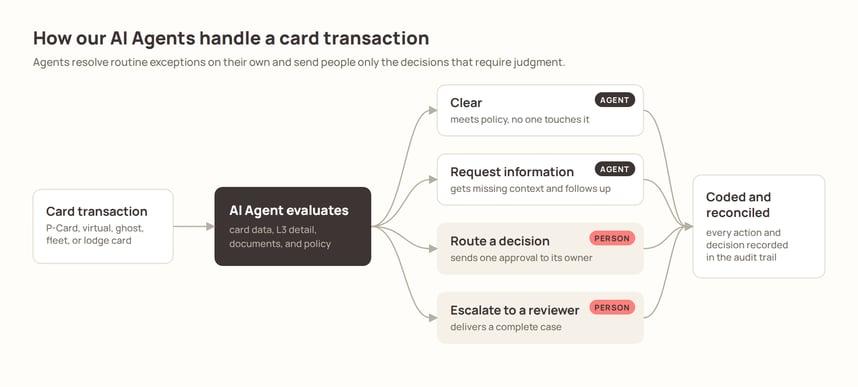
To evaluate a transaction, an AppZen Agent reads the card data, the merchant information, and Level 3 (L3) card data where the issuer provides it. It also reviews supporting documents, supplier and entity context, program rules, and company policy. The Agent uses that evidence to determine what was purchased and whether the purchase meets policy. It keeps a complete record of each action and decision.
What does Autonomous Cards cover?
Autonomous Cards supports purchasing cards, virtual cards, ghost cards, fleet cards, and centrally billed lodge cards. We match the Agent workflows and analytics to each card program, transaction type, and business context. Here's how AI Agents operate on each connected card program.
- Work across existing card programs as one consistent AI and compliance layer, so the company keeps its current banks and cards.
- Evaluate every eligible non-T&E transaction against card data, merchant information, available L3 card data, supporting documents, supplier and entity context, program rules, and company policy.
- Determine what was purchased from line items and other evidence, even when the merchant name alone does not reveal the nature of the purchase, by leveraging L3 data where available.
- Obtain missing information or documentation from the appropriate source and follow each transaction until it is resolved.
- Apply company policy consistently, identifying split purchases, restricted items, duplicate or recurring charges, off-contract spend, and transactions that need more evidence.
- Resolve routine exceptions on their own. An Agent clears the transaction, requests information, routes a decision, or escalates the case to a person when it requires human judgment.
- Code each transaction, reconcile it against card statements and systems of record, and keep a complete record of every action and decision.
Where AI Agents make the difference
Employees use corporate cards at every hour of the day and in every time zone. Autonomous Cards works around the clock, reviewing each card transaction as it posts, flagging every charge that breaks your policy, and taking action to resolve low-risk spend. Your finance team uploads their card policies and SOPs, and our agentic AI applies them to every cardholder in every department.
Here are the capabilities that make Autonomous Cards so effective.
Knowing what was purchased
A program team that sees only the merchant name knows who was paid. The team often cannot tell what the company bought. A charge from a large online retailer, for example, may cover office supplies, a laptop, or a gift card. Our Agents review line items and other available evidence to identify the purchase itself. They then apply the policy that fits the purchase. Many ghost and lodge card transactions have no individual cardholder to ask. On those programs, our Agents rely on line items and supporting documents to establish the purchase.
Retrieving missing context
When context or documentation is missing, an Agent identifies the appropriate source. It requests or retrieves the missing item, follows up, and tracks the transaction to completion. Program teams see the status and outcome of every item, and nobody has to chase each one by hand.
Applying one policy across programs
Our Agents apply company policy the same way on every connected card program. They identify split purchases, restricted items, duplicate or recurring charges, and off-contract spend. They also flag transactions that need more evidence before anyone clears them. An Agent then clears the transaction, requests information, routes a decision, or escalates the case to a person.
Handing reviewers a complete case
When a transaction requires human review, the designated reviewer receives a complete case. Our Agents assemble the supporting documents, line items, policy and risk findings, prior Agent actions, and transaction history. The case also includes a recommended action. The reviewer decides without rebuilding the transaction from several systems, and our Agents record that decision in the audit trail.
Turn card data into spend intelligence
Our AI Agents turn raw card data into spend intelligence for each card program. In our analytics, we distinguish who was paid from what was purchased. We use merchant and spend taxonomies relevant to purchasing, virtual, ghost, fleet, and lodge card programs.
Finance, procurement, and card program leaders analyze spend by program, supplier, category, entity, and geography. They identify off-contract spend, duplicate and recurring charges, restricted purchases, unowned transactions, and other leakage. They also find opportunities for savings, supplier consolidation, rebates, and wider card adoption.
Leaders see what happened after our Agents flagged a transaction. For each item, they see whether the Agents resolved it on their own, gathered more context, or escalated it for a person’s judgment. They can also see which items remain open. With that record, leaders measure autonomous resolution, remaining exposure, and realized value for each card program.
Expand card programs, not workloads
Enterprises face a trade-off in every card program. A company gains economic benefits when it moves more spend to cards. It also takes on more administration and risk with each new card and transaction.
Our AI Agents take the repetitive work off the program team. They continuously monitor eligible transactions and turn card data into insights for the team to act on. Finance teams expand card adoption while maintaining policy enforcement, explainability, and control. A company can increase card spend without a matching rise in administrative burden or exposure.
The bottom line on Autonomous Cards
We designed Autonomous Cards for non-T&E card operations in which AI Agents do the primary work. Our Agents monitor spend and resolve routine exceptions, while people control the decisions that require judgment, and leaders measure the performance of every card program.
AppZen Autonomous Cards will be generally available beginning October 26, 2026. To learn more, contact us to schedule a demo.
Frequently asked questions
What is AppZen Autonomous Cards?
Autonomous Cards is an agent-first automation, compliance, and spend intelligence layer for non-T&E enterprise card programs. Our AI Agents monitor eligible transactions, apply company policy, resolve routine exceptions, and turn card data into spend intelligence.
Do companies have to change banks or card issuers?
Companies keep their current banks, issuers, and card programs. Autonomous Cards connects to existing purchasing, virtual, ghost, fleet, and lodge cards.
Which card programs does Autonomous Cards support?
Autonomous Cards supports purchasing cards, virtual cards, ghost cards, fleet cards, and centrally billed lodge cards. We match the Agent workflows and analytics to each program, transaction type, and business context.
What happens when a transaction needs human review?
Our Agents route the transaction to the designated reviewer as a complete case. The case includes supporting documents, line items, policy and risk findings, prior Agent actions, transaction history, and a recommended action. Our Agents then record the reviewer’s decision in the audit trail.
When will Autonomous Cards be generally available?
Autonomous Cards will be generally available beginning October 26, 2026.