

AI in finance falls into three tool categories. Chatbots answer questions from a script. Assistive AI drafts and summarizes while a person decides. AI agents check each document against your policy, act on it, and send exceptions to a person. Finance leaders match each task to a tool based on how easily their team checks the output.
Key takeaways
- The three AI tools used most often in finance are chatbots, assistive AI, and AI agents. Each one handles specific tasks.
- Finance leaders get the fastest payback from AI in finance beginning with the tasks that consume their team’s hours, analyzing the team’s work before comparing vendors.
- AI agents handle verifiable finance work, such as invoice matching and policy checks, because a reviewer confirms each result against a rule or a document.
- An AI agent belongs in a finance workflow only after a named approver signs off on its policy and every action it takes lands in an audit trail.
Every finance team feels pressure to do something with AI. Boards ask chief financial officers (CFOs) for an AI plan. Vendors attach the same two letters to very different products. One label now covers a scripted chatbot and software that audits every transaction on its own. In our recent webinar, “AI for finance leaders 101,” we identified the substance behind that pressure. Protiviti’s Global Finance Trends Survey found that 72% of finance teams used AI tools in 2025, up from 34% in 2024. Few other corporate functions have adopted a technology that quickly.
Finance leaders need a clear way to sort the options. To determine how AI can help your team, you first need to understand the main types of AI, how they apply to finance, and how to look past the headlines to determine what real deployments indicate. It’s also helpful to compare adoption across five industries and apply a tested framework within your own team.
The spectrum of AI in finance, from chatbots to agents
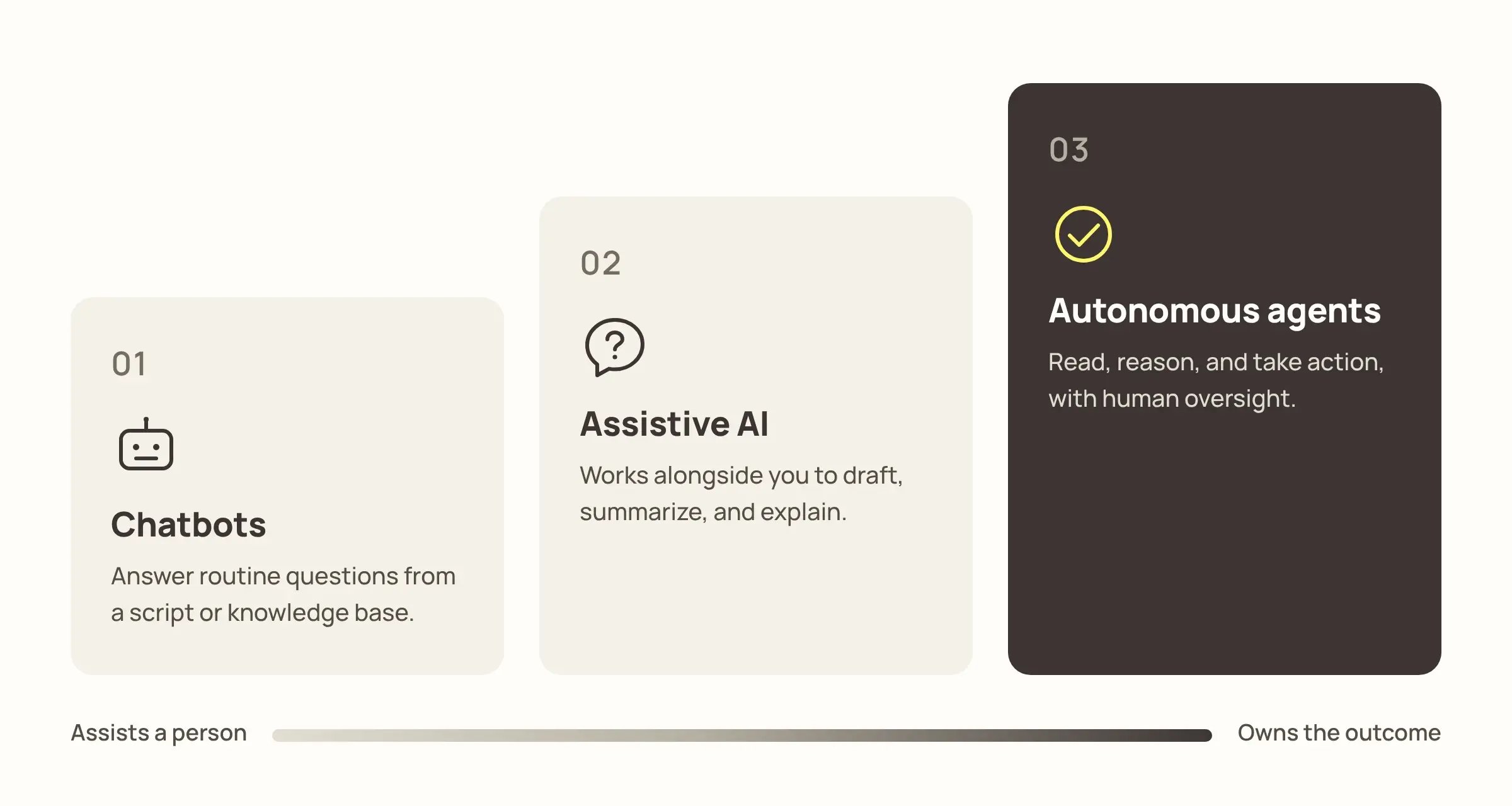
We find it useful to place each type of AI commonly used in finance along a spectrum. At one end, the software assists a person. At the other end, it owns the outcome. The products along that line carry different risk levels and deliver different value to a finance team. Most companies sit somewhere in the middle today. They run models and assistive AI in production, and many of them now test agents.
Chatbots follow a script
You have likely met a helpful chatbot assistant on a support page. It may offer you a help center link, or help you contact the right representative to solve your issue. Developers configure chatbots with fixed scripts. The chatbot cannot make decisions on its own. It answers your questions based on the key words and phrases it hears, asks you for clarification, and hands the real work to a person.
Assistive AI works alongside a person
Assistive AI comes in two versions. The first is a prompt-driven tool, such as ChatGPT, that fetches information, such as an invoice, or summarizes a document on request. The second runs in the background on a single task. An extraction model, for example, reads each expense document as it arrives and presents the results within the limits you set. In both versions, the AI handles routine steps and surfaces context, but a person makes the decisions and takes action.
AI agents handle the full workflow
An AI agent reads a document, reasons about it, and acts, based on the guardrails you have set for it. Think of a travel assistant agent. You tell the agent you want to book a vacation in Hawaii, and it gathers options, weighs them, and books the trip for you. In accounts payable (AP), an agent receives an invoice and extracts its data. It then compares that data with records in your other systems and checks the invoice against your policies. The agent can email a supplier to respond to a payment request, or message an employee to request a missing PO. It decides on an action within the limits you set, and it brings a person in only for a true exception. Your team reviews exceptions instead of every line item.
What the headlines miss about AI in finance
Finance teams read alarming coverage every week. Reporters tie workforce cuts to AI, and employees wonder what that means for their own jobs. It helps to separate two sources of information. Headlines report what companies intend. Deployments show what the technology does reliably today.
Here are three common headlines, tested against that standard.
“AI is coming for your finance team.” Picture an AP specialist today. The specialist spends most of the day keying in invoice data, matching purchase orders (POs), and chasing approvals. AI takes over the repetitive, high-volume tasks first, such as data extraction and line-item matching. The specialist keeps the tasks that made the role valuable, including vendor relationships, dispute resolution, and judgment calls on ambiguous cases. The specialist spends less time typing and more time deciding.
“Automate your whole department overnight.” Today, AP teams touch every invoice, whether or not anything is wrong with it. With agents in place, the agents process routine invoices, and people see only the exceptions. Each flagged item arrives with the agent’s reasoning attached, so your team supervises the system and handles the cases that need human judgment.
“Those we cannot reskill will be exited.” Companies that automate internal tasks redirect their people to other work, and they keep hiring. When a finance organization deploys AI with clear controls, the team sees agents handle the tedious work. Every escalated case then reaches a person through a controlled process.
Why finance leaders should pay attention to large AI partnerships
Reporters also cover a wave of AI partnerships. Companies form them for three reasons. Competitors in every sector are embedding AI into core workflows, and there is competition to adopt. The technology has also matured, with reasoning models, agent frameworks, and guardrails ready for enterprise use. A partnership also lets a company replace open-ended research spending with an investment it can govern and measure.
In February 2026, Amazon and OpenAI announced a partnership in which Amazon invested $50 billion in OpenAI. The two companies are building a stateful runtime environment on Amazon Bedrock, where AI agents keep context, remember prior work, and act across multiple systems.
Amazon also applies AI inside Amazon Business, which serves more than 8 million organizations and generates over $35 billion in annualized gross sales, according to the company’s November 2025 announcement. Its AI features lie along the same spectrum described above.
- Amazon Business Assistant is a chatbot that answers buyers’ questions about account setup, purchasing, and savings inside the buying workflow.
- Savings Insights assists Business Prime members by analyzing purchase history and surfacing cost-saving recommendations.
- Spend Anomaly Monitoring flags unusual purchases, including orders split to stay under approval thresholds.
- Buy for Me autonomously completes purchases on a customer’s behalf on external merchant sites.
Amazon matches each AI type to a specific job and keeps people in control of spending decisions. Finance leaders face the same design choice in their own operations.
AI in finance across five industries
I see this same pattern in other industries. Companies in the same category tend to start on the same part of the spectrum. Yet leaders in each sector have pulled well ahead because they’ve adopted AI with a plan, while laggards talk about it. Here are four industries, viewed through the lens of where finance teams see AI first: expense audit and accounts payable.
Manufacturing makes a clear case for agents
Manufacturers deal with thousands of suppliers, multiple plants, and multiple enterprise resource planning (ERP) systems. Their AP teams run high-volume three-way matching against POs and receipts. Agents handle this rules-heavy work well, from ingestion and extraction to matching and exception routing. People review only the ambiguous cases.
Airbus, Boeing, and Owens Corning run finance operations on our platform today. Their teams clear backlogs, make judgment calls, and no longer touch every invoice to get there.
Education needs capacity without new headcount
Universities run lean back offices, with AP spread across departments. Invoice volume peaks sharply during enrollment season, and grant and restricted-fund rules require extra compliance checks. In this sector, AI gives a small team capacity it could never add by hand. Agents absorb the enrollment crunch and check restricted-fund rules automatically. Georgetown University automated its decentralized AP with our platform. The university cut processing time by 74% and increased throughput without changing headcount.
Finance industry maturity
Financial services firms run the most mature AI programs of the four sectors, with agents already working in customer service and fraud detection. Their finance teams only approve an agent if it leaves an auditable record of every decision it makes.
Fast-moving professional services
Professional services firms may have started adopting AI later, but are quickly catching up. Although fewer firms run agentic tools today, many have plans to deploy them soon. Their finance teams feel the most pressure at month-end close, because the firm cannot send client invoices until the close finishes.
How to evaluate AI for your finance team
Here is an evaluation framework to use when considering AI agents for your finance team: start by analyzing your team’s workload; determine which insights you need most; place each task on a verifiability spectrum; and consider change management from day one.
Start with where your team’s time goes
Ask which tasks consume your team’s hours right now. Regardless of the claims made during a vendor’s demo, this is where your team will recover time the fastest. Most finance teams spend the greatest number of hours on four tasks.
- Matching invoices to POs and receipts.
- Chasing down approvals and exceptions.
- Reviewing expense reports line by line.
- Building reports and reconciling accounts by hand at month’s end.
Map your team’s hours before you evaluate any tool. AI pays back first on the task that takes your team the most hours, and that task differs from team to team.
Decide what you need to see
Next, list the insight your team needs and what other people expect from you. Inside the team, you need to know close status and where bottlenecks exist, spend by category and vendor, and policy exceptions as they happen. Outside the team, auditors want audit trails on demand, and your board and investors expect accurate reporting.
Finance and IT often judge AI on different scorecards. Finance teams focus on cost and want certainty before they commit. IT teams track technical metrics that rarely connect to cost. Tie each technical metric to a cost outcome, so both teams are using the same scorecard.
Match the level of autonomy with verifiability
To determine how much work to give AI, first consider how easily you can check the output. A verifiability spectrum can help you decide. To place a task on the spectrum, ask how easy it is for a person to check the AI’s output.
- Level one covers verifiable work. A reviewer checks the result against a rule, a policy, or a matching document. Invoice matching, policy checks, and duplicate detection fit here. AI handles these tasks autonomously.
- Level two covers judgment-adjacent work. Emails, summaries, and reports fit here. The AI drafts each one, and a person reviews it before it’s sent.
- Level three covers human work. Negotiations, sensitive conversations, and relationship calls fit here. The AI prepares a briefing, and a person does the work.
Use the spectrum to decide which tasks suit AI, then decide how much autonomy to give the AI for each. The easier a task is to verify, the more autonomy it earns. Our guide to evaluating AI agents covers this decision in more depth.
Plan for change management
Teams that adopt AI successfully plan for four factors. Most teams address only one or two of them.
- Secure a leadership mandate. Confirm that executives support the effort and tie it to a larger business initiative. Without that strategy, teams run pilot after pilot and never scale any of them.
- Set the budget and measure ROI. Add up the total cost of ownership, including integration, maintenance, and downtime, and estimate how quickly the investment will be paid back.
- Build internal adoption. Name the people who will champion the change every day. Deloitte’s State of AI in the Enterprise report, published in January 2026, found that 84% of organizations had not redesigned jobs around AI.
- Prepare for outside scrutiny. Show vendors, auditors, and clients how you govern AI, so they trust its results.
The same Deloitte report found that only 25% of organizations had moved 40% or more of their AI experiments into production. Another 54% expected to reach that level within three to six months. Plan for all four factors early, and your pilots have a clearer path into production. For a step-by-step approach, read our AI workforce framework.
Build a hybrid finance workforce on clear governance
Embedding AI in daily operations is more than a tool upgrade; it changes how your finance team works. The result is what we call a hybrid finance workforce, where people and AI agents share the work.
Agents in that workforce need three guardrails. First, define the policies the agent follows, so everyone can see the rules it applies. Next, require a full audit trail. Without one, your team pays a “verification tax,” re-checking each result and asking how the tool reached it. Finally, set clear limits on when the agent may act alone and when it must hand off work to a person.
How to deploy a governed agent
Finance teams follow five steps when putting an agent into production.
- Define the policy. Write it in natural language, the way you would instruct a colleague, and include the conditions the agent must check.
- Run a simulation. Ask the agent to replay past transactions from a sample of your data and show how it would have handled each one. If the results surprise you, refine the policy and run the simulation again.
- Ask for a named approval. Have a manager or executive review the simulation and sign off on its output. Log who approved the agent and when.
- Deploy and review. Once live, confirm the agent applied the approved policy to new transactions and logged every decision. For example, the agent flags a restaurant charge that lacks an itemized receipt and auto-approves a coffee purchase under $50.
- Manage versions. Version control allows you to edit the policy or roll back to an earlier version. Logged history records who made each change.
Teams need more control as they give AI more autonomy. While a chatbot that runs a fixed script and an assistive AI tool that asks before it acts are fine for work within a limited scope, an agent that acts on its own requires teams to hand it explicit policies and regularly review its record.
People keep the judgment
In a hybrid workforce, agents manage the routine queue, including ingestion, coding, and standard processing. Your people handle vendor relationships, oversight, and the strategy for where the team heads next. Ultimately, you decide how much work each AI agent takes on and where your people stay in the loop. Set an agent to process routine invoices on its own, or route every exception to a reviewer before anything posts. Your SOPs define the rules, and the agent follows them as written. The “black box” becomes a “glass box.” You can see why the agent took each action and adjust the guardrails until the results match what you expect.
Every AppZen AI Agent consistently follows your standard operating procedures (SOPs). Our SOP-driven agentic AI logs every action for audit. Our platform connects with SAP Concur, Workday, and SAP BTP, and works with your ERP and expense management system (EMS). It is also available on AWS Marketplace.
The bottom line on AI for finance leaders
Finance leaders who sort AI into clear categories make better buying decisions. Start with the hours your team spends today, and give AI full autonomy only where a reviewer checks every result against a rule. Before any agent goes live, require a named approver, a simulation, and an audit trail.
We meet finance teams wherever they are in their AI journey, from their first assistive tool to our AI Agents that audit every transaction. Our dedicated team works with yours to find where AI improves your processes today. We then match the right technology to your finance tech stack. As your team builds trust in the results, we support adoption one step at a time. Each step proves its value before you take the next one.
To explore AI for Finance Leaders 101 in more depth, check out the first session in our webinar series. Each subsequent session takes on a current topic in AI for finance, from new research to the questions your peers ask most.