


CFOs measure the ROI of AI agents for accounts payable by the share of work transitioned from people to agents, using cycle time, policy consistency, spend leakage prevented, and end-user experience as the reporting metrics.
Key takeaways
- Evaluate AI agent performance against four metrics: cycle time, consistency of policy application, dollars of spend leakage prevented before disbursement, and end-user experience. Each corresponds to a figure finance leaders report on.
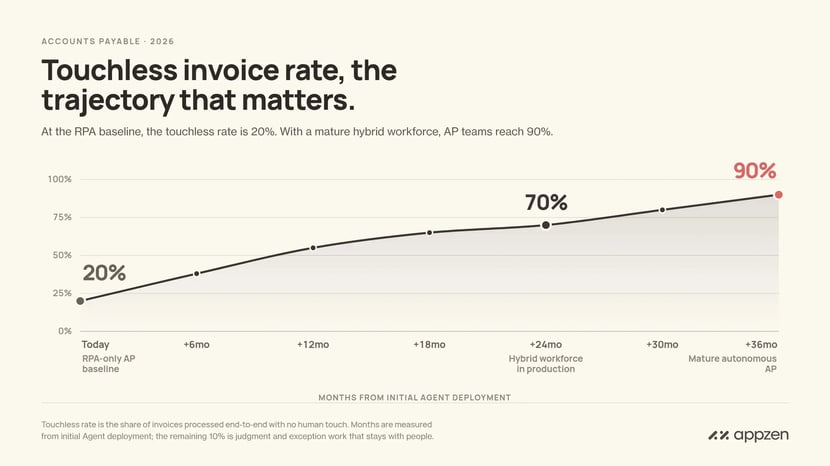
- The true touchless rate is the share of invoices that no employee or offshore or BPO reviewer touches between receipt and payment-ready. RPA-only operations run near 0%. A hybrid workforce in production runs at 70% touchless. Mature autonomous accounts payable reaches 90%.
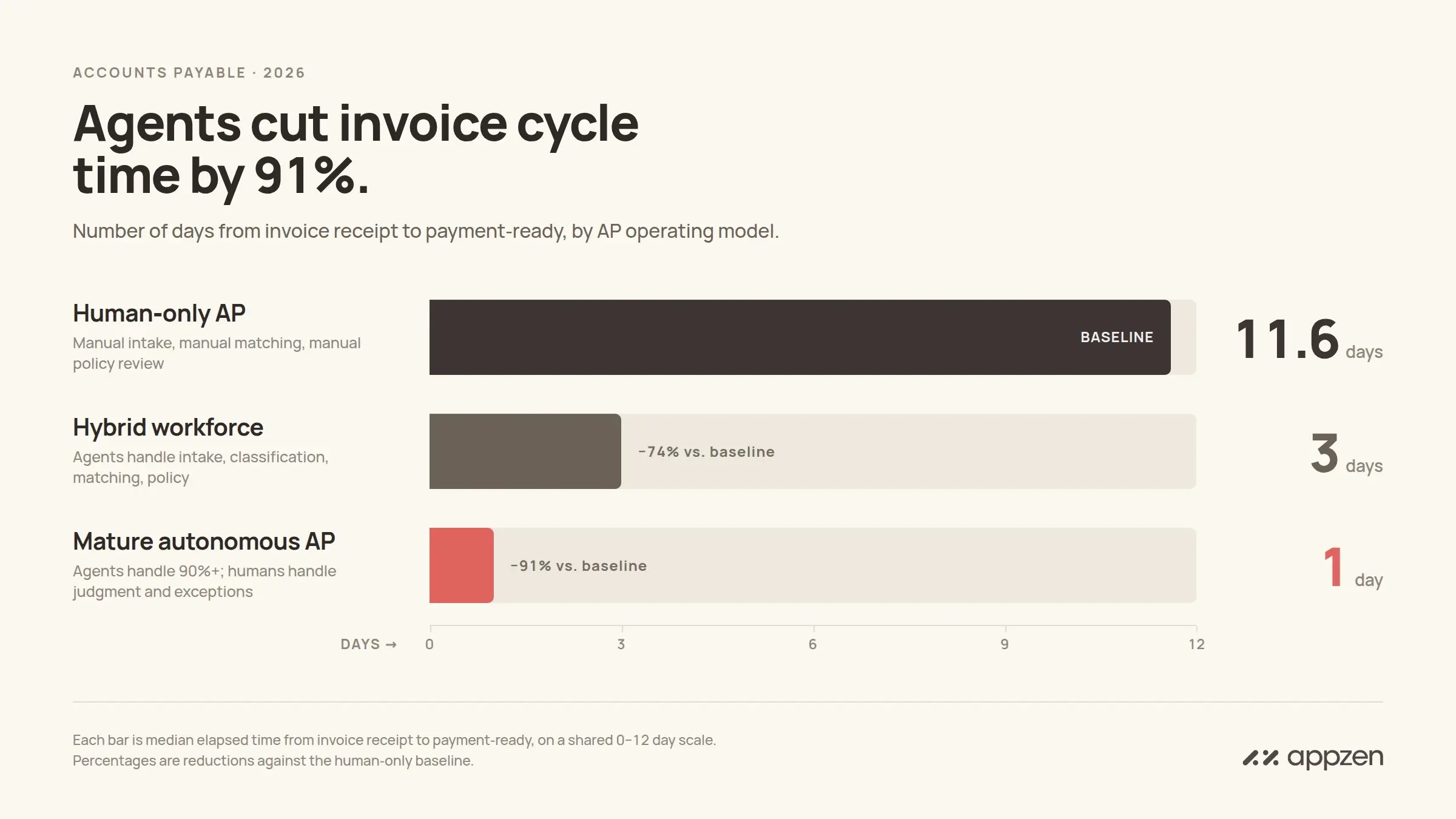
- Cycle time is the earliest measurable indicator. Ardent Partners reports an average human-only AP cycle time of 11.6 days in 2026. Hybrid operations reach 3 days within 12 months and 1 day at maturity.
- Document a Transition Map before selecting an automation platform. The targets are 40 to 50% true touchless at 90 days, 70% at 180 days, and 85 to 90% at 365 days, reported against the labor cost run rate.
AI agents for accounts payable ROI starts with work transitioned
MIT's NANDA initiative reported in “The GenAI Divide: State of AI in Business 2025” that roughly 95% of enterprise generative AI initiatives fail to deliver measurable financial impact. In our experience, those that do succeed share a defining trait: they do not count AI agents, but instead measure the value of the work that people handed off to digital workers within hybrid teams.
A hybrid workforce brings humans and digital workers, such as AI agents, under the same workflows, dashboards, and governance. This is no longer experimental. It is the operating model disciplined finance organizations are converging on.
Accounts payable (AP) leaders evaluating AI agents in 2026 should not be asking how many people an agent can replace. They should focus on how much work across AP and vendor relationship management teams is being absorbed by a digital workforce. Measuring the value of that transition to the P&L is the real metric that indicates success. We have spent the last decade building both the AI Agents that execute the work and the dashboard that measures the work they take on.
Every GBS or finance leader approving a new AP or vendor relationship management hire should first evaluate whether an AI Agent can accurately complete the required work with full governance and auditability. That is the new scaling rule for finance.
What is offshoring costing your accounts payable operations?
Finance back office operations underwent a significant transformation in the 1990s, driven by business process outsourcing (BPO) and offshoring to shared services centers. Last year, BPO contracts with third parties in India and the Philippines, where AP and vendor management desks sit, cost roughly $8–25 per fully loaded hour. While shared shared service centers maintain tighter quality control, even in the same geographies the fixed costs are higher, running $25–40 per loaded hour.
Both models are effective, but they also carry costs CFOs have learned to absorb. A 25 to 30% annual workforce churn creates a retraining burden it creates. Limited regional and cultural context can break when policies change. Language gaps quietly degrade vendor relationships. And running a global team incurs costs related to travel and time-zone overlap.
The question for 2026 is what a hybrid digital workforce does to the cost base beneath that model. When an AI agent can accurately perform the same tasks with full governance and human oversight, CFOs can scale operations, increase control, and bring work back in-house without burdening their existing teams.
Why labor-replacement ROI framing is too narrow
The labor-replacement ROI framing works only when labor is the binding constraint. In modern finance back-office operations, it is not. The binding constraints are cycle time, compliance integrity, leakage at the policy gate, and the experience finance delivers to the business. Throughput-only ROI undercounts what an agent does. Labor-only ROI misses the value of work humans cannot perform consistently at scale, such as cross-referencing every invoice against the correct PO and goods receipt, in every language, in real time, with audit-grade rationale on every flagged case.
The CEO wants speed. The CFO wants permanence.
The CEO is focused on time to value. A measurable shift in production within 90 days, with the touchless rate moving, cycle time dropping, and a real number on the dashboard that the audit committee can see.
The CFO is focused on permanent impact. Headcount and BPO contract reductions in year one provide the hard cash that pays for the program before the other benefits compound. Everything else, including compliance, leakage, and end-user experience, accumulates on top of the year-one cash savings, which remain the primary return on an agentic AI investment.
The value levers of AI agents for accounts payable
The agentic AI ROI conversation should be organized around four levers. Each maps to a metric finance already reports on. Together, they provide the complete picture of what a hybrid workforce made up of AI agents produces.
Lever 1: Operational efficiency and cycle time
Measure cycle time across finance back-office processes, such as invoice receipt-to-payment-ready and vendor inquiry-to-resolution. According to Ardent Partners, human-only AP cycle times in 2026 average 11.6 days. We have seen a hybrid workforce reduce that to 3 days within the first 12 months, as our AI Agents handle intake, classification, matching, and policy reviews. A mature, autonomous accounts payable, in which our AI Agents handle over 90% of the processing and humans handle the tough exceptions and judgment calls, reduces cycle time to 1 day. The same trajectory applies across vendor relationship management.
Lever 2: Compliance and consistency
Agents apply every policy to every transaction without fatigue. A human auditor reviewing 300 invoices a day assigns the correct general ledger (GL) account and cost center, based on the vendor, description, and requestor, with roughly 85% consistency by hour six. Our AI Agent assigns it at 99.9% consistency across 300,000 invoices a day. It’s the same pattern for vendor onboarding due diligence, and any policy that requires consistent application across volume. Not only is this an efficiency gain, it is also a control surface that did not previously exist.
Lever 3: Spend leakage prevented
Measure the dollar value of duplicates, fraud, and out-of-policy spend caught before disbursement. Agents catch what humans cannot, such as same-vendor, same-amount, same-PO matches across millions of records; cross-language vendor aliases; and fragmented PO references. The value is measured in dollars held back before disbursement. This lever converts AI from an operating-cost decision into a working-capital decision.
Lever 4: End-user experience
Measure the experience of submitters, suppliers, and approvers from time-to-status, touches per ticket, and multilingual coverage. Historically, finance could not improve the internal customer experience without adding headcount. Agents change that.
From five regional teams to one global finance back office with a multilingual unlock
When agents read every invoice and vendor email in every language and operate 24 hours a day, the historical reasons for splitting AP operations into regional teams disappear. The finance organizations making the most aggressive transformations today are consolidating regional centers for AP and vendor relationship management into global hubs, each with one set of controls, one cycle-time metric, and one consolidated cost figure.
Our Digital Workforce Productivity Dashboard reports on these four levers by default. They are the four answers a CFO needs before approving the next AI line item.
How the four value levers reach the P&L
Each lever translates into a line a CFO already defends in the boardroom. Throughput and autonomy compress the cost-to-serve across finance back-office operations, lifting operating margin and EBITDA. Reduced BPO contract spend and captive-center headcount pay for the program in year one. They are direct, permanent, and defensible to the audit committee. Returned capacity lowers the marginal cost of growth. Net economic value from policy enforcement and preventing duplicate payments releases working capital and protects free cash flow.
The digital workforce becomes an operating-expense line on the P&L that produces a compounding return. That is why governed agent productivity is a Board-level operating conversation, not an IT discussion.
“True touchless” is the goal of the hybrid workforce
What does “true touchless” mean?
A true touchless operation is one in which no one in the company touches the transaction. This does not mean an agent did most of the work. At no point from receipt to payment-ready did an AP clerk, offshore reviewer, or exception handler review the transaction.
In “true touchless” operations, humans never need to review transactions. This is the bar that is now set for agentic operations. If a human has to touch every one, the human is still the bottleneck. Speeding up a bottleneck isn't the same as removing it.
The 70% and 90% points on the graph below illustrate the percentage of invoices processed in true touchless operations. In the mature state, the remaining 10% is the only work that actually requires human judgment.
The hybrid workforce blueprint, before and after
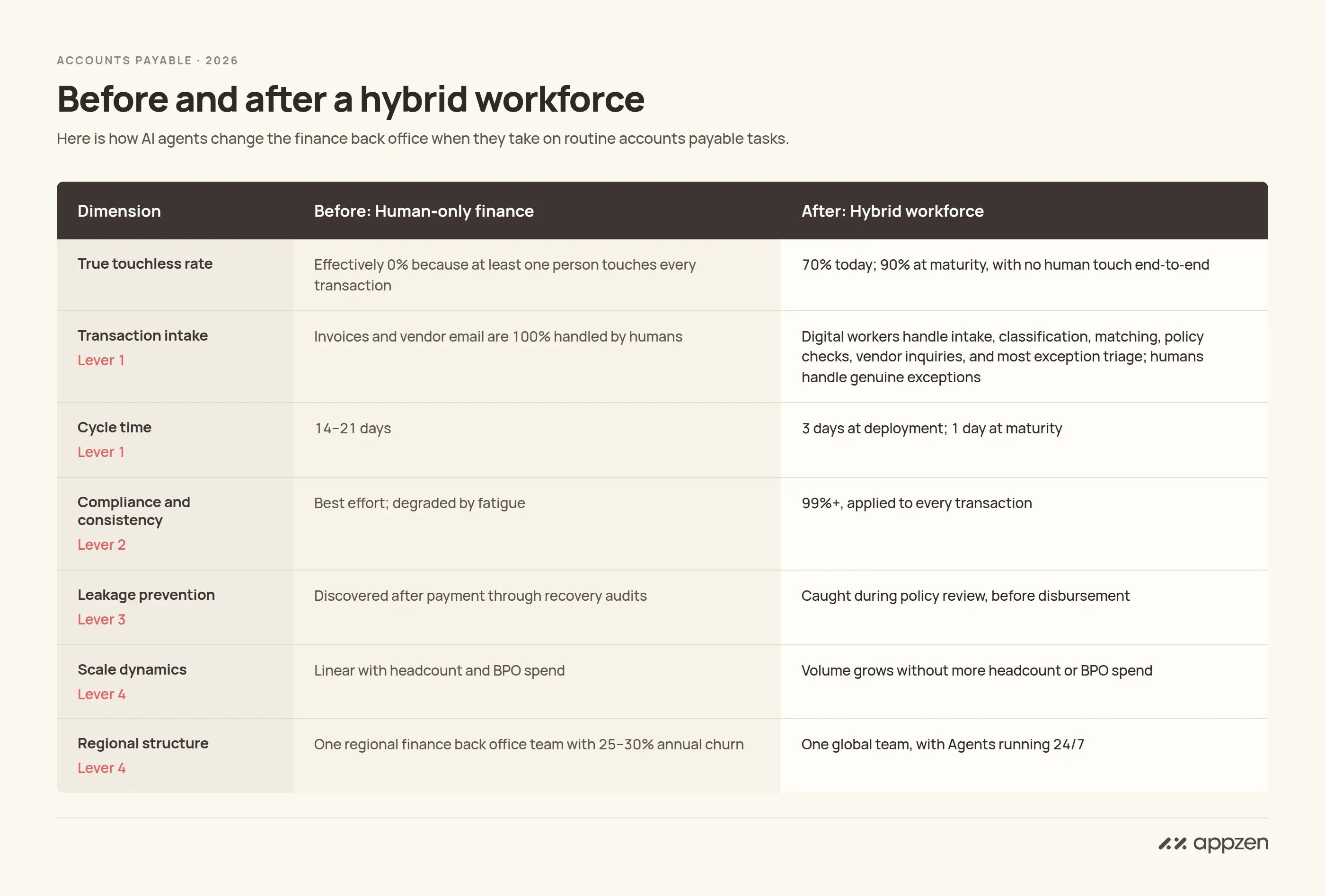
This chart reflects what AP looks like today for our customers with AI Agents in production. The 'after' column in this chart is not aspirational; the numbers come from our live dashboard.
Plan your ROI before deployment with the 90/180/365 Transition Map
A Transition Map is a document that answers the question of what percentage of the work you are prepared to transition to AI agents in the next 90, 180, and 365 days. The finance back-office operations leader owns the Transition Map, and the CFO signs off on it. That shifts the conversation from “Which platform?” to “Which work do we hand off first?” Build this artifact before you evaluate any platform.
90 days: Foundation
Deploy out-of-the-box, best-practice agents on work that requires no policy customization. Tasks may include invoice intake and classification, three-way match, duplicate detection, and vendor email triage. These kinds of agents are typically pre-configured for the most common cases. The CFO sees a measurable lift in true touchless rate within the first reporting cycle. Target: 40–50% true touchless.
180 days: Expansion
A dashboard report will show which tasks humans are still doing by transaction type, policy, region, and exception class. This report becomes the basis for the wave-two deployment plan, adjusting custom T&E policies, region-specific tax handling, vendor onboarding due diligence, and any exception triage requiring institutional knowledge. Regional consolidation begins here. Target: 70% true touchless.
365 days: Maturity
Agents handle approvals, supplier communications, audit prep, payment-run release, and the long tail of judgment cases. Target: 85–90% true touchless. The hybrid workforce is now the operating model across the back office.
After deployment, the four levers become the live scorecard and the labor cost line bends down. Captive-center headcount comes off the run rate. BPO contracts are renegotiated or discontinued. The dollars released fund the next wave of agents. The remaining human capacity moves into vendor risk, regulatory readiness, FP&A business partnering, and audit committee work. This is a permanent reduction in finance operating cost, with compounding gains in compliance, leakage prevention, and cycle-time compression.
How AppZen enables the hybrid finance workforce
We built the Mastermind AI Automation Platform as the control surface for the hybrid finance workforce. Every one of our Agents is governed, and every action is audit-traceable. The Digital Workforce Productivity Dashboard makes hybrid workforce ROI measurable rather than asserted. With our Agents in production at Fortune 500 finance organizations, we are recognized as best-in-class for Autonomous AP.
How CFOs govern and measure the hybrid workforce
Our Digital Workforce Productivity Dashboard is how CFOs and AP leaders monitor their hybrid workforce. It is a reporting layer within the same system that controls the Agents themselves, and it covers the four levers that affect the business. Productivity numbers and controls are in one place, so you don’t have to reconcile two parallel reports at month-end.
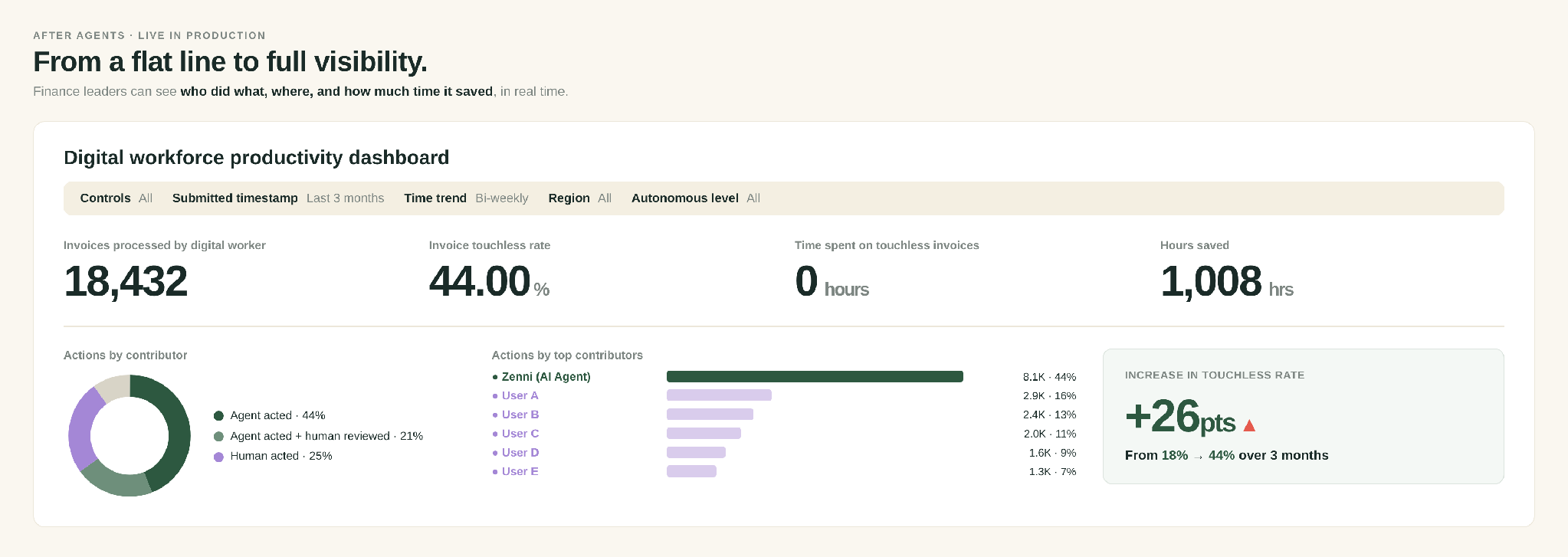
The Digital Workforce Productivity Dashboard for Autonomous AP reports on live AI Agents. Here, 18,432 invoices have been processed at a 44% touchless rate, saving 1,008 hours, for a 26-point touchless lift within the first three months of AI Agent deployment.
What our AI Agent dashboard surfaces
A work-transition chart showing the share of work still performed by people versus digital workers, broken down by process, transaction type, vendor, region, and policy.
An opportunity heat map for agents indicating where to deploy agents next, for the greatest ROI. The dashboard ranks the transactions, policies, and exception classes that still consume the most human time by addressable touchless lift. It natively creates the same view a consulting firm would charge to produce. This makes the Transition Map a living document.
Touchless-rate trajectory as you progress toward 90%, shown alongside the true-touchless line so the audit committee can see how much volume moves with zero human contact.
Compliance and leakage stopped, with dollars held back based on policy, and an audit-grade rationale for every flagged case.
Labor cost run rate showing headcount, BPO spend, and captive-center cost tracked against the touchless-rate trajectory, so the CFO can see exactly when the cost line bends.
The bottom line: Three commitments for AP leaders
Three commitments separate finance organizations that will operationalize AI from those that will report another stalled initiative in the next budget cycle.
- Ask whether an AI Agent can do the work before hiring a person.
- Build a 90/180/365-day Transition Map before evaluating platforms, not after.
- Measure every AI deployment against the four levers, on the same dashboard that controls the agents, with the labor cost run-rate line in plain view.
Following these steps turns a hybrid workforce into an operating advantage rather than an experiment. This is how a finance organization joins the 5% MIT found delivering measurable impact.
Frequently asked questions
What are AI Agents for accounts payable?
AI Agents for Accounts Payable, or Autonomous Accounts Payable, are software agents that execute AP work such as invoice intake, classification, three-way match against the PO and goods receipt, policy enforcement, duplicate detection, and exception triage. They operate autonomously and at scale, with audit-grade rationale for every action. The same architecture extends across T&E audit and vendor relationship management, making accounts payable the entry point to a fully hybrid finance back office.
What is “true touchless” invoice processing?
True touchless means no one in the company touched the invoice from receipt to payment-ready. It does not mean an agent did most of it or an offshore reviewer handled the easy cases. It is the share of transactions that move through intake, matching, policy, and authorization without a human keystroke from anyone onshore, offshore, in a BPO, or in a captive center. RPA-only AP runs near 0% true touchless. A hybrid workforce in production runs at 70%. Mature autonomous AP reaches 90%.
What is a hybrid workforce in finance?
A hybrid finance workforce brings human workers and digital workers, or AI Agents, onto the same workflows, dashboards, and controls across AP, T&E, and vendor relationship management. Agents handle high-volume, rules-based work and most exception triage. Humans handle the small set of cases that genuinely require judgment and the strategic work they were hired to do: vendor risk, policy design, FP&A business partnering, and audit preparation.
How do CFOs measure ROI from AI Agents in Accounts Payable?
CFOs measure four value levers together, on top of permanent labor cost reduction: operational efficiency through cycle time; compliance and consistency through policy hit rate; spend leakage prevented through dollars held at the gate; and end-user experience through time to status and multilingual coverage. Underneath all four is the labor line: headcount reduction in captive centers and BPO contracts renegotiated or discontinued.
What is the Digital Workforce Productivity Dashboard?
The Digital Workforce Productivity Dashboard is the control surface for a hybrid finance workforce. It shows the share of work performed by people versus digital workers, the opportunity heat map for where to deploy agents next, the touchless-rate trajectory including the true-touchless line, dollars held at the policy gate, and the labor cost run rate. All of it sits on the same governance spine that runs the agents.