

Research indicates finance leaders are increasingly using agentic AI expense audit to check every transaction against policy before payment, at a scale manual teams cannot reach. They're making the shift because manual expense sampling reviews only a small, high-risk subset of transactions after money has already left the business, an approach that misses non-compliance, leaves errors undetected, and lets fraud run unchecked. Here are the trends we discovered when we explored our customer data across industries.

Key takeaways
-
Expense auditing is now a strategic, forward-looking capability. In 2026, AI-powered expense auditing is a core pillar of autonomous finance, redefining the CFO role. AppZen customers audited 258M lines in 2025.
-
Agentic AI delivers measurable operational and strategic value. Organizations gain speed and accuracy, detect fraud earlier, and free finance teams to focus on strategic work. AI processes a report in 2.3 minutes, against a 4-day manual average.
-
The gap is widening, and decisive action is critical. Companies that delay risk falling behind on the ability to scale, maintain control, and generate insight. Automation rates of 95%+ are achievable with AI agents, while 8% of human-audited work contains errors.
From steward of the balance sheet to architect of autonomous finance
In 2025, AppZen’s AI Agents saved organizations $126 million by autonomously reviewing card transactions and receipts, cross-checking policies, and escalating anomalies before a single dollar was spent.
Today’s CFOs are shifting from stewards of the balance sheet to architects of enterprise-wide transformation, building autonomous systems that protect cash flow, enforce policy, and surface risk in real time. This change is powered by agentic AI: systems of intelligent AI agents that perceive, decide, and act across finance workflows without the need for human intervention.
AI expense audit has become the proving ground. By using agentic AI to review 100% of transactions against policy before payment, organizations running these autonomous audit processes are already seeing a reduction of up to 91.4% in manual detective work, with fewer exceptions routed to finance teams.
The real question is no longer whether to adopt agentic AI. It is whether you can afford to scale without it.
The expense landscape in 2025
We've analyzed insights from millions of transactions across our global customer base to identify the expense audit trends defining autonomous finance in 2026 and beyond. Here is where the numbers stood at the close of 2025.
3.5M+
Expense lines transferable to AI Agents
1 in 5
Flagged out-of-policy travel expenses rejected
$1,040
Average reimbursement per report
75×
Year-over-year increase in suspicious spend detection
Trend 01: Finance leaders are making spend control an AI function
Finance leaders are making spend control an AI function so every transaction is reviewed before payment, at a scale that manual teams cannot meet.
Deloitte’s Q4 2025 CFO data shows that 49% of CFOs now rank automating processes to free employees for higher-value work as their #1 talent priority for 2026. And its State of AI in the Enterprise report indicates that two-thirds of organizations have already captured productivity and efficiency gains from AI. Current market realities make this shift urgent.
Fortune 500 enterprises face a shrinking pool of senior audit talent. Manual expense sampling, the practice of reviewing a small, high-risk subset of transactions after they have already been paid, can no longer keep pace. A reactive approach leads to missed non-compliance, undetected errors, and unchecked fraud.
Organizations are moving beyond adding a tool to the tech stack. They are building sustainable workforce assets with digital agents: tangible skills that AI agents build and operate, holding their value across teams so people are freed from repeating the same manual work. Spend control becomes a technical function that AI agents own.
What makes an AI system agentic in finance
- Perception. The Agent reads receipts, invoices, bookings, and policy context.
- Decisioning. The Agent applies policy, risk models, and spend thresholds in real time.
- Action. The Agent approves, rejects, escalates, or routes the line without waiting.
A learning loop closes the sequence. The Agent improves its accuracy over time based on outcomes and auditor corrections.
How we’re helping organizations make this shift
$126M
AI Agent savings, up 4%
258M
Expense lines audited
500+
Customer-built AI Agents
2.3 min
AI vs. 4-day manual
Finance teams build those Agents themselves in AI Agent Studio, and they run on the Mastermind AI platform.
Trend 02: Autonomous governance for business travel
Business travel is no longer a static line item. It is a dynamic operational variable that demands real-time governance. Our data confirms that 1 in 5 airfare and hotel expenses flagged as out-of-policy travel spend result in rejection.
Where the risk lives
Routine categories, such as local transportation, car mileage, and individual meals, are straightforward, with autonomous approval or rejection rates above 63%. The real opportunity lies in high-value categories, where autonomous AI transforms complex “gray area” spend into clear, policy-driven outcomes.
- Airfare discrepancies. Employees book non-compliant classes of service, personal travel add-ons, and duplicate bookings.
- Hotel policy violations. Travelers use non-preferred vendors and take personal stay extensions.
- Ancillary charge misuse. Expense reports include unjustified room upgrades and prohibited charges like mini-bar fees or in-room movies.
Ground transportation reveals the sharpest opportunity. Many companies still group Uber, Lyft, and traditional cabs under a single “Taxi” category, hiding significant waste. More than half of all taxi expenses still require manual review, and 19% are rejected.
How our agentic AI manages spend control
Manual audits struggle to balance compliance enforcement with a frictionless employee experience. AI Agents handle both at scale. Our AI provides real-time validation that manual processes can’t match, comparing submitted receipts against employee roles, market rates, and corporate policy rules, then flagging discrepancies before bookings are finalized. Finance teams get the same treatment for corporate cards through Card Audit and full spend visibility across every category.
Trend 03: Protecting cash flow by validating before payment
Post-payment audit is fundamentally flawed. By the time a transaction is reviewed, the money is already gone, and recovery is slow, inconsistent, and often incomplete. Pre-payment validation, checking every transaction against policy before payment is released, eliminates the need for recovery.
The measurable impact on reimbursement behavior
The industry average trip spend has reached $1,128, according to the Global Business Travel Association (GBTA). Across all industries AppZen tracks, real-time auditing of 100% of spend brought the average reimbursement from $1,220 in 2024 to $1,040 in 2025. That 15% year-over-year decline and the resulting gap below the industry benchmark reflect the direct impact of policy-driven finance workflows that validate transactions before payment.
“AppZen’s cash line validation saved us almost $400,000 in one year. Without that flag, we would have reimbursed the employee and paid Amex. We’d be paying twice.”
Shirley Yu
Travel & Expense Leader, Toyota
Reimbursement trends across our top five industries
A platform-wide average spans every industry we serve. Here are numbers from the top five. The overall average can fall while reimbursement claims in several individual industries rise, because reimbursement behavior diverges by sector.
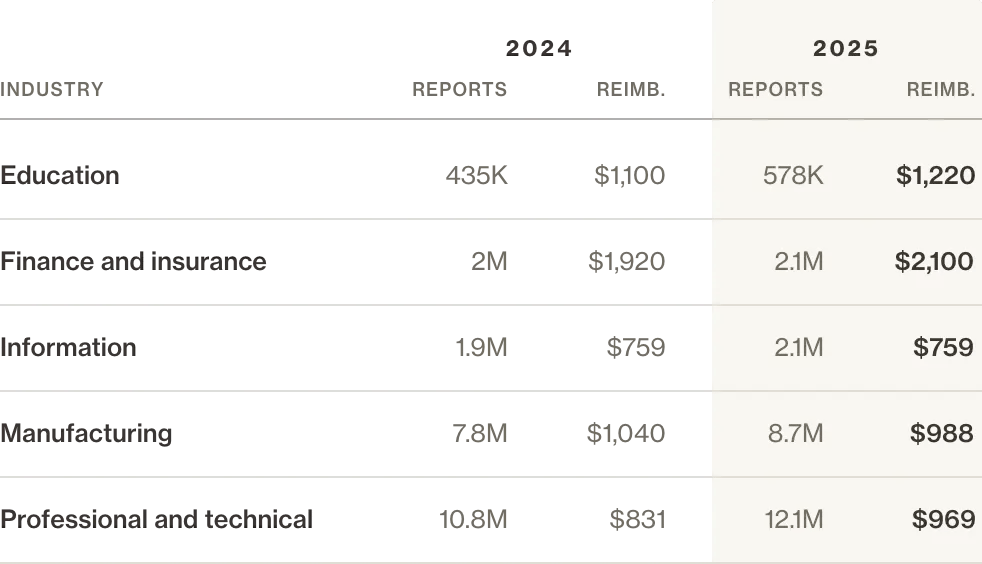
Education, finance and insurance, and professional and technical services saw claim sizes rise as airfare, lodging, and a return to in-person meetings pushed costs up. Information held flat at $759. Manufacturing was the only industry to post a decline: claim size fell 5% year over year while report volume grew 12% over the same period.
Trend 04: AI is transforming expense operations
Agentic AI is changing how employees and finance teams interact with corporate policy. We are seeing year-over-year behavioral shifts as our AI takes on the role of an active digital coworker. Global enterprises use our solutions to help with four operational actions.
- Error reduction. Expense Audit catches simple typos, like a $34.50 train fare that was miskeyed as $345.00, before reimbursement.
- Proactive guidance. Our AI provides policy clarity before expenses are finalized, reducing violations.
- Real-time validation. Audit checks compare submitted receipts against employee-entered data to uncover discrepancies.
- Threshold validation. Our AI flags expense items exceeding policy limits, such as a $1,000 hotel charge made against a $500 threshold, for auditor review.
Autonomous resolution rates across our top five industries
To best understand how industries are adopting our AI Agents, we benchmark their autonomous resolution rates, meaning the share of expense lines our AI Agents approve, reject, or route without human input. The higher the rate, the more the audit workload is being processed by Agents rather than the human workforce.
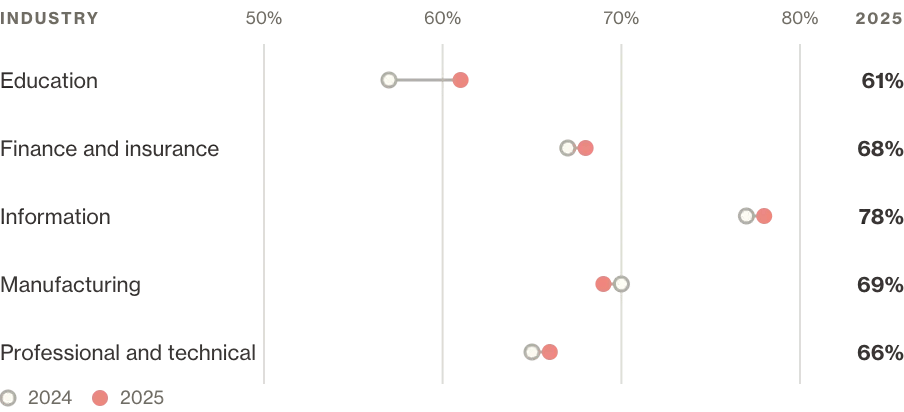
Every industry is automating, each at its own pace, rather than on one shared curve. At 78%, the information industry has the highest autonomous rate and is the most mature program in our customer base, with most of the audit work completed by AI Agents. Education jumped four points to 61% in a single year, the fastest gain of any sector. Manufacturing slipped a point, a useful reminder that adoption rarely moves in a straight line.
Trend 05: AI exposes expense fraud at scale
Organizations lose an estimated 5% of revenue to fraud each year, according to the Association of Certified Fraud Examiners (ACFE). Generative AI tools now make it easy to create convincing fake receipts in seconds, putting new pressure on expense fraud detection.
Before the advent of widely available generative AI, fake receipt websites produced millions of fabricated receipts. Our Agents caught roughly 5,950 fake receipts tied to these sites and 1,548 AI-generated receipts, all flagged for human review before reimbursement. Since then, the scale of AI-generated fake receipts has only increased, and fabrication at that scale represents tens of thousands of dollars in exposure. Manual audits cannot keep pace, making AI the most viable path to 100% expense audit coverage. Our fraud and risk detection Agents carry much of that load.
7,500+
Fake and AI-generated receipts caught, Mar 2025–May 2026
$151K+
Spend stopped before reimbursement
How our layered defenses scaled in 2025
Detection volume grew sharply year over year, 2024 to 2025.
30×
More merchant validity checks
75×
More suspicious spend detected
2×
More advanced spend anomalies detected
What our AI catches: Real customer data
100% audit coverage surfaces more than fake receipts. Here are some of the additional expenses our AI found in 2025 by auditing every transaction. Manual sampling would never have caught this kind of spend, which slips through when only a small amount is reviewed after payment.
Real expenses, flagged before reimbursement
- Lip fillers
- Backstreet Boys tickets
- A paternity test
- €1,000 in candy over two years
- Legal counsel to get out of a DUI
- A Britney Spears costume
- A hair weave
- The purchase of a car
- A boat charter
- A tire rotation after hitting a curb in a rental car
Trend 06: Moving to a hybrid workforce reduces cycle time and headcount
The future of finance teams is a hybrid workforce, where AI Agents handle high-volume, rules-based work and people focus on judgment. We analyzed 40 of our enterprise customers to understand how their Expense Audit programs are changing as our AI Agents take on more work. The pattern is clear.
3.5M+
Expense lines reviewed by Agents
80 FTEs
Capacity unlocked across 40 organizations
136K
Audit hours saved per year
Teams using AI Agents audit expense reports in minutes rather than days. Their headcount remains flat or shrinks while transaction volume grows. When teams hand off work to a digital workforce, the changes show up clearly in cycle time and headcount.
Bringing offshore work back in-house
For years, the cost-effective way to scale high-volume finance work was to send it to business process outsourcing (BPO) providers or offshore for finance control, visibility, and lower labor costs.
Our AI Agents change that calculation. They complete the high-volume, rules-based work that once justified an offshore or BPO team, running on companies’ own standard operating procedures (SOPs), and every action is visible to your team. The economics of AI agents versus traditional staffing have begun reversing decades of outsourcing and offshoring, freeing people to do the work that requires real human expertise: investigating exceptions, improving policy, and proactively addressing fraud and risk. Across the 40 organizations we analyzed, that shift gave roughly 80 full-time employees 136,000 audit hours of additional capacity per year, redirected to higher-value finance work.
The importance of AI governance and audit trails
Handing finance work to autonomous agents only works if you can prove the work is governed, explainable, and audit-ready. We build our AI Agents from SOPs rather than from hard-coded, one-off workflows, so they apply the logic your team already uses — the same way every time, at any volume. This removes the audit friction that appears when different auditors interpret procedures differently.
The Agent also leaves a record of every action: what it reviewed, which policy it applied, and why it approved, rejected, or escalated the review to a human. Every decision can then be reconstructed on demand, rather than needing to be pieced together after the fact.
Because we hold our Agents to a high standard, we also govern the models behind those Agents the way finance governs every other control. This governance rests on three pillars.
- Trust. Every model is benchmarked against a golden data set and tested before it reaches production.
- Monitor. We track model performance daily rather than spot-checking it, so drift is caught early.
- Remediate. We escalate any accuracy decline with incident-level severity and rigor.
Together, SOP-driven execution and continuous model governance give finance leaders the confidence for the next evolution: a digital hybrid workforce. Teams that do not yet use agents are absorbing the cost in longer cycle times, hiring pressure, and fraud exposure. The finance leaders making these changes now are halving their operating costs, hitting automation rates of 95% or more, and scaling without adding headcount.
The path to autonomous finance: A CFO’s readiness checklist
Autonomous finance expands your team’s capacity. AI Agents review every transaction so your people can spend their time on judgment. Use this checklist to gauge how ready your organization is to make the shift. Work through these and you build a finance function that scales with volume, not headcount, and stays in control as it grows.
- Set an autonomy target. Commit to an automation-rate goal so you can grow transaction volume without growing headcount.
- Move controls before payment. Audit pre-payment to stop leakage before it happens, not after the money is gone.
- Audit every transaction. Replace manual sampling with 100% coverage and surface the risk hiding in transactions no one checks.
- Turn policy into enforceable thresholds. Codify corporate policy as clear approval limits agents can act on, so only genuine exceptions reach a person.
- Govern once, globally. Enforce one policy consistently across every entity and region from a single control point.
- Treat AI as a coworker. Give an agent ownership of a workflow and hold it accountable to a number. This mindset shift unlocks all of the above.
Customer proof
Leading enterprises are already making this shift
Across industries, finance teams running on AppZen AI Agents are auditing more, faster, and with fewer people, halving operating costs and scaling without adding headcount.
$483K
Databricks saved hundreds of thousands, annually. The team deployed custom AI expense models that flagged unauthorized spend, driving new corporate card policies and tighter controls.
$200K
Airbus removed wasteful spend. AI-driven expense auditing delivered full visibility into global spend.
2,000
Owens Corning saved thousands of audit hours in one year. Autonomous expense management replaced manual review processes.
“We shortened our turnaround time on most audits by a full day. And that is, honestly, our requirement. Typically reports are through in the same day that they come in, just because the exact expenses to review are highlighted and the process is just so quick and clean.”
Merin Schrinel
Global Travel and Expense Manager, Owens Corning
Frequently asked questions
What is AI expense audit?
AI expense audit is the use of agentic AI to review expense transactions against corporate policy before payment. AI Agents read receipts, apply rules, and approve, reject, or escalate each one — letting finance teams audit 100% of spend in real time.
How does AI expense audit detect fraud?
AI expense audit detects fraud by checking every transaction against policy, market rates, and known fraud patterns before payment — flagging fake and AI-generated receipts, duplicate bookings, and out-of-policy spend that manual sampling would miss.
What is 100% expense audit coverage?
Under 100% expense audit coverage, every expense transaction is reviewed before payment. Agentic AI makes full coverage practical by processing transactions in minutes at any volume, where manual teams can review only a small sample.
What is autonomous finance?
Autonomous finance is a model in which AI Agents own high-volume finance workflows from perception to decision to action, under human governance, while people focus on exceptions, policy, and risk.
How much manual work can AI expense audit remove?
AppZen customers have reduced manual detective work by up to 91.4% and cut processing time to about 2.3 minutes per report, versus an average of four days for manual review.
Resources
Deloitte Q4 2025 CFO Signals survey, Deloitte. Q4 2025.
State of AI in the Enterprise, Deloitte.
Global business travel spending forecast, Global Business Travel Association (GBTA). 2025.
Report to the Nations 2026, Association of Certified Fraud Examiners (ACFE). 2026.
AI-generated fake receipts are changing expense fraud, Forbes. June 28, 2026.
Your AI fake receipts defensive playbook for expense audit, AppZen.