


Finance 2030: The Future of Finance Technology, released by Gartner at the end of 2025, outlined how AP, T&E, and shared services teams will transform within the next four to five years. Gartner laid out their technology assessment in the form of six themes.
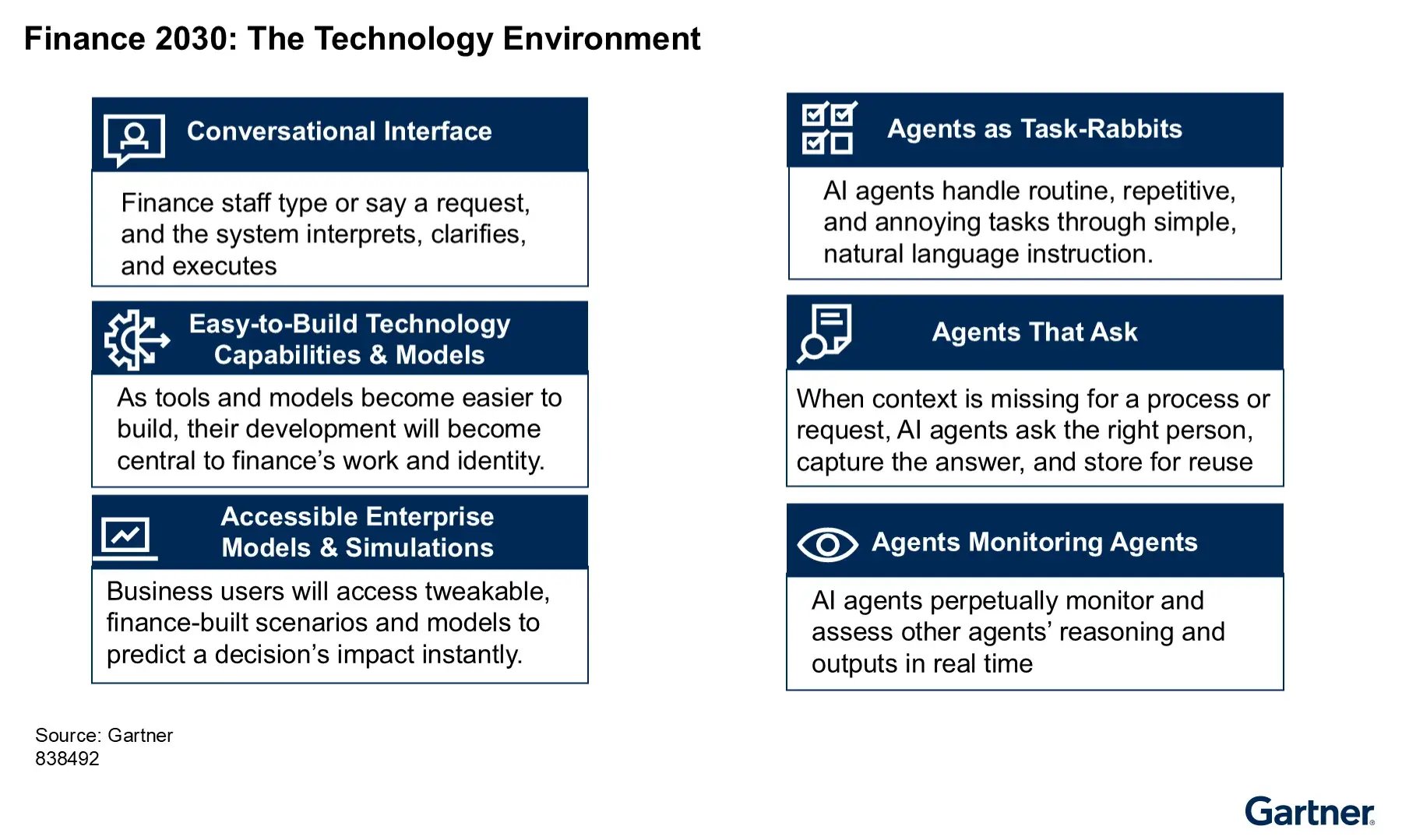 “Finance 2030: The Technology Environment” is a trademark of Gartner, Inc. and/or its affiliates.
These are the technology themes reshaping finance
To us, Gartner’s research is more confirmation than prediction. These six technology themes document what leading finance teams have already deployed with AppZen’s Mastermind AI Automation Platform.
In the midst of this transformation, they’ve gained faster operations, reduced their risk exposure, and attracted talent who want to work with cutting-edge technology. They’re creating a whole new class of employees who manage the AI that handles tedious tasks. They’re able to focus on “soft skills” and strategic work that requires human judgment, like improving relationships with vendors and approval managers, engaging with complex edge cases, and adapting business to the realities of changing markets.
For example, one financial institution recently redirected 34 of its 40-person expense audit team to other work, while the remaining six team members manage AppZen’s AI Agents. These Agents handle the scanning, policy checking, and exception flagging which used to consume the entire department. They’ve moved beyond learning gaps and AI pilots to a production reality that is providing competitive value.
Companies are increasingly looking to create similar technology environments over the second half of this decade. Here’s an explanation of each of Gartner’s six themes and how they translate into ROI for our customers.
Theme 1: Conversational interfaces
Gartner’s position: “By 2030, finance teams will work conversationally with enterprise applications, typing or speaking natural language requests to retrieve data, run analyses, or reconcile transactions as easily as talking to a colleague.”
Finance teams are already “talking” with enterprise applications, and the shift is delivering measurable results. One CFO.com survey found that 79% of FP&A teams have adopted AI tools, with 93% employing conversational AI platforms like ChatGPT to streamline their work. Natural language processing lets finance professionals interact with data using everyday questions rather than complex formulas. Ask “What was our Q2 marketing spend versus budget?” or “Which departments exceeded forecasted expenses by more than 10%?” and get instant, accurate answers. As interfaces continue to improve, finance teams will manage LLMs and AI agents that interpret and execute tasks, retrieving, analyzing, and creating visualizations instantly without navigating complex menus and forms.
How AppZen delivers conversational interfaces today
AppZen’s AI Agent Studio democratizes access to AI for finance professionals by enabling more natural interaction with finance workflows. Instead of forcing users to navigate complex expense management or AP systems, using tools like AI Analytics lets finance teams “talk to the data” and converse naturally with the AI Agents taking independent action on their behalf. These teams are becoming AI power users without ever needing to learn code.
Read Gartner’s “Finance 2030: The Future of Finance Technology,” and dive deeper into the 6 areas of technology most likely to affect your finance team before the end of the decade.

Theme 2: Easy-to-build technology capabilities
Gartner’s position: “By 2030, finance teams will use AI development platforms to build or configure AI agents, predictive models, and applications to drive operational efficiency and improve decision making.”
Gartner sees finance staff routinely creating simple tools, models, and agents using natural language prompts. This shifts finance teams from technology consumers to technology creators. The barrier to AI development becomes a mindset rather than a technical skill. According to Gartner’s 2025 forecast, the low-code development technologies market is projected to reach $58.2 billion by 2029, driven by agentic AI, citizen development, and operational excellence initiatives. No-code platforms are eliminating “translation latency,” that frustrating gap when finance requirements get lost in communication with IT departments. With these tools, finance professionals who understand approval hierarchies and compliance requirements can build automated processes on their own.
How AppZen delivers easy-to-build technology today
Easy-to-build capabilities sit at the core of AppZen’s AI Agent Studio and low-code workflow automation. Finance teams simply upload their standard operating procedures to the AI Agent Studio, and the platform instantly transforms them into working AI Agents that execute around the clock. The Mastermind AI Automation Platform lets finance professionals create custom workflows, configure AI Agents, and build automated AI processes without writing a single line of code.
Theme 3: Accessible enterprise models and simulations
Gartner’s position: “By 2030, frontier finance teams will deliver intuitive, AI-powered enterprise simulations that enable a broad set of decision makers to run real-time ‘what if?’ scenarios independently, shrinking decision cycles while improving outcome quality.”
As more business users benefit from finance-built scenarios, Gartner predicts finance will shift from producing static reports to managing a portfolio of AI-driven models and simulations that do the work themselves. AI embedded in planning and analytics tools will accelerate this by suggesting drivers, optimizing algorithms, and evaluating outputs so models can be created, refined, and scaled faster. Building a basic model or simulation will become nearly instantaneous for end users. While more robust, enterprise-grade forecasts will still require human judgment and expertise, these AI models will significantly speed up and simplify the process.
How AppZen delivers accessible enterprise models today
AppZen focuses primarily on operational finance like expenses, AP, and card transactions, but our capabilities directly support freeing up finance capacity for strategic modeling. Our AI Analytics capabilities and AI Coach feature also surface spending patterns, identify cost-saving opportunities, and recommend policy optimizations. These are all foundational analytics that inform scenario modeling. By automating the transactional work that consumes analyst time, AppZen creates the capacity for finance teams to build and manage the simulation portfolios Gartner describes. After all, you can’t run sophisticated “what-if” scenarios if your team is buried in manual expense audits and invoice processing.
Theme 4: Agents as task rabbits
Gartner’s position: “AI agents will eliminate intermediate process steps, such as finding information or moving and manipulating data, from finance workflows. This will require finance to learn to build, configure, and oversee its own AI agent portfolio.”
If 2023 was the year of the generative AI chatbot and 2024 was the year of the copilot, 2025 was the year of the AI agent. Gartner’s October 2025 research revealed that 57% of finance teams were already implementing agentic AI or planning to implement it in the near future. Unlike brittle RPA scripts that break when systems change, AI agents can employ reasoning techniques, reflect on interim outputs, and adapt to changing systems through natural language instruction. By 2030, asking an AI chatbot to perform a task and watching it route that task to an agent that completes it successfully will be as routine as checking email.
How AppZen delivers agents as task rabbits today
This is AppZen’s core business. Our Expense Audit and Autonomous AP solutions deploy AI and AI Agents that automatically scan receipts, check policies, flag exceptions, validate invoices, match purchase orders, and handle GL coding. Customers are achieving over 80% autonomous processing with AI across expense audits and accounts payable. A financial institution that used AppZen’s agentic AI to redirected 34 of its 40-person expense audit team to other tasks is scaling the work with governance and auditability built in from day one.
Theme 5: Agents that ask
Gartner’s position: “By 2030, finance will rely on ‘agents that ask’ to capture the business context and institutional knowledge that used to live only in people’s heads. These agents continuously query users and systems for missing information, building a living knowledge base that dismantles silos and delivers guidance at the point of work.”
AI agents will analyze policies, standard operating procedures (SOPs), and conversational transcripts to identify gaps and trigger other agents to fill them. Some agents will periodically review policies for ambiguities and update guidance when new regulations appear. Others will query compliance teams, propagate changes across processes, and handle large-scale information gathering by asking targeted questions to relevant staff and sharing answers broadly. For example, requirements gathering and process mapping tasks that currently consume weeks of meetings and documentation could be offloaded to agents that interview users, cross-check logs against best practices, and highlight patterns and opportunities.
How AppZen delivers agents that ask today
AppZen’s ZenLM framework provides the finance-specific intelligence layer that powers autonomous operations with the accuracy, contextual awareness, and explainability that generic models can’t achieve. When AppZen flags an expense as potentially non-compliant, the system explains why it was rejected, showing the specific policy rule that applies and the evidence from the receipt that triggered the flag. Our AI-first Expense Audit comparison highlights how AppZen’s advanced receipt analysis can distinguish between a "Spa” brand water purchase and a luxury “spa” visit by asking itself, “What type of transaction is this really?” and making nuanced, contextual determinations. It also learns from auditor feedback and SOPs, to build out a customized, secure database of policy knowledge that never goes on vacation.
Theme 6: Agents monitoring agents
Gartner’s position: “By 2030, finance staff will manage an additional layer of agentic AI supervision above and between human and agent workflows. In this layer, specialized AI agents monitor and evaluate other agents’ reasoning, tool use, and outputs. This continuous oversight catches errors and policy breaches in real time, reducing the risk of misstatements and compliance failures.”
According to Gartner’s research, only 14% of organizations report having the proper governance in place to manage AI agents or the novel security challenges introduced by AI assistants. This governance gap is what’s preventing the other 86% from scaling beyond tentative pilots. Organizations cite unresolved questions around data privacy, explainability, and model misuse. Technology platforms are evolving to support this supervision layer. Organizations implementing mature AI governance report 40% faster incident response and 60% reduction in false positives through automated policy enforcement.
How AppZen delivers agents monitoring agents today
AppZen maintains the strict guardrails and audit trail capabilities required by CIOs and CFOs alike. Our Private ZenLM models also address the governance challenge head-on by ensuring sensitive data never leaves isolated customer environments while still enabling AI automation. AppZen’s monitoring, compliance tracking, and audit capabilities provide exactly the oversight layer Gartner describes, maintaining comprehensive audit trails that show why each expense was approved or flagged, which AppZen AI Agent made the decision, and which policy rules applied.
Start your finance 2030 transformation today
When one of our customers redirected 85% of its staff to higher-value work, it was through deploying AI Agents with proper governance. And it started capturing competitive advantage immediately. Many of its peers are still evaluating whether to begin pilots.
Gartner’s six themes—conversational interfaces, easy-to-build capabilities, accessible models, agents as task rabbits, agents that ask, and agents monitoring agents—describe a future that AppZen is already delivering. The research makes clear that competitive advantage by 2030 will come from organizations that start now, experiment deliberately, and build the governance frameworks that make safe scaling possible. Finance leaders evaluating AI strategies have a straightforward task ahead of them: capturing an AI advantage today or playing catch-up tomorrow.
If you’re ready to fast forward your finance operations to 2030, contact us. We’ll show you how AppZen’s Mastermind AI Automation platform for Expense Audit and Accounts Payable creates the strategic advantage that puts your organization ahead of the game.